
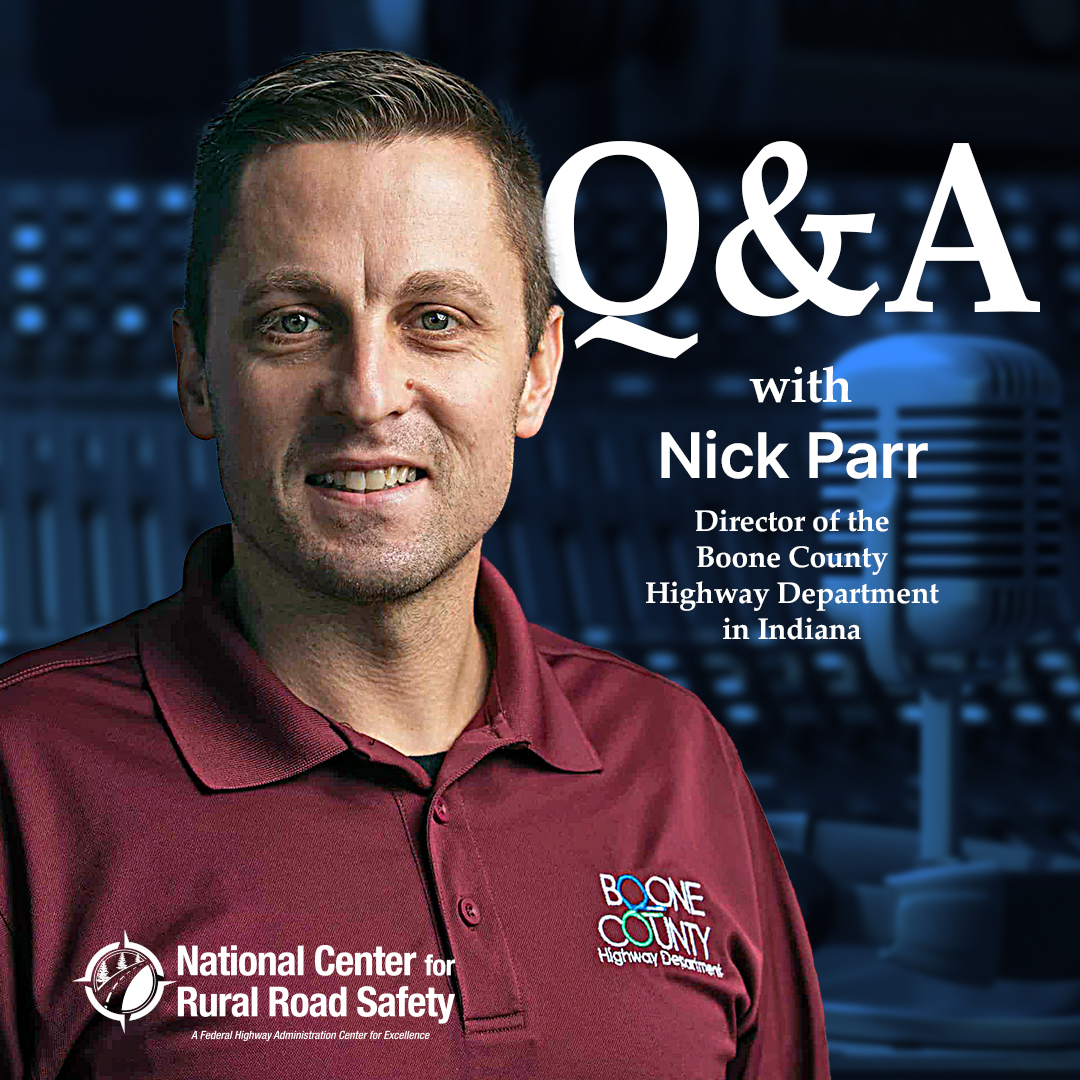
Nick Parr is the director of the Boone County Highway Department in Indiana. In this episode, Kevin talks with Nick about his decades long experience in rural road safety and how his department has evolved over the years, now regularly identifying opportunities to implement the Safe System Approach.
Listen to the full episode and access resources here: https://ruralsafetycenter.org/home-safely-podcast/#parr
Q&A
Q: How did you end up in this job — what’s your background and how did you become director of highways?
A: I started here almost 20 years ago, working out on the roads, with different crews … I worked my way up through different opportunities to lead crews, and now I lead the entire department.
Q: How is Boone County laid out in terms of rural vs. urban — what is “out there” like?
A: We have about 720 miles (centerline) that we take care of, and about 300 miles of that are still gravel roads. We have a very urbanized area near the growing fringe of the metro, but also very rural agricultural areas that remain sparsely populated. It’s almost like two different counties — urban and rural — within the same county.
Question 3: What are some ways that driving in the rural areas differs from driving in more urban areas of your county?
A: When someone leaves the urban or town streets and gets onto rural roads, it’s a very different experience — for drivers, for cyclists, for pedestrians, for farm and agriculture traffic. Traffic tends to increase near towns, but rural roads don’t evolve at the same rate. You get long straight roads, wide-open farmland, farm equipment, slow vehicles, and faster vehicles all mixing — and driver behavior changes dramatically depending on the setting and even the time of year (for example, when crops are up vs. when fields are bare).
Q: What are the most common types of severe crashes you see in Boone County, especially on rural roads?
A: The most common severe crash type is lane departures — drivers leaving the side of the roadway, perhaps to avoid an animal or another car. But the crashes that tend to cause injuries or fatalities happen at intersections. Almost always those serious crashes are at intersections — frequently when visibility is blocked (for example by tall crops or vegetation), or when drivers assume an intersection works like a four-way stop, or simply disregard stop signs. We average about one fatality per year on our network.
Q: What are you doing — what strategies are you using — to mitigate those crashes and improve safety on rural roads in Boone County?
A: We do a lot of things: controlling speeds where we can, but speed control is hard because people drive at what they feel comfortable with. Because many roads don’t have enough width for shoulders or rumble strips, we rely on lower-cost, practical countermeasures: adding pavement markings (edge lines and center lines) where roads previously had none, adding stop bars, ‘stop ahead’ messages, extra signage (including additional stop signs, spinning alerts, and stop-ahead signs even when not strictly warranted) — anything to draw a driver’s attention when something is different.
We also tapped into federal funds (after creating a local road safety plan) to pay for these improvements — 90 % of costs covered, which made it feasible. We’ve replaced faded, low-reflectivity signs for better visibility at night. We even built a roundabout at one intersection that had multiple fatalities, though in the short term we added a four-way stop with full markings while the roundabout is being planned.
We bundle safety improvements with regular paving or resurfacing projects: when we hire a contractor to pave a road we ask them to include striping or extra safety features — that save money and makes it more efficient. Overall, I’d say we are trying to be proactive — not waiting for crashes to occur before we act, but looking for locations with risky characteristics, then proactively addressing them.